Tides, homemade. Picture this: a bathtub full of water — and us in the middle of it. When we move, the water sloshes back and forth. How fast the bathtub wave moves through the water depends on the water depth — that is, how full the tub is. The speed of the wave is vividly called propagation speed, and it is calculated quite simply as the square root of the product of water depth (in metres) and the gravitational acceleration constant. Standing beside the bathtub with one hand in the water, we watch a nice little flood disaster at a certain rhythmic, uncompromising back-and-forth. It takes very little force to make the 80, 100 or more litres of water in the tub overflow.
To produce visible tidal effects you need huge amounts of water. Even a marginal sea like the Baltic is not enough. The Mediterranean has tide-related water-level excursions (tidal range) of between 10 and 30 cm.

The Atlantic between Europe and America (see the NASA animation below) is a huge bathtub. Ebb and flood can form here, as in the oceans in general, and appear as gigantic sloshing motions. The geometry of the Atlantic is nearly ideal for working like a perfectly sloshing bathtub. What, though, has enough power to keep shoving these water masses permanently and in sync? The Atlantic bathtub holds something like 330 million cubic kilometres of water. A little wind, or even a lot of wind, is not enough as a tidal drive — far too imprecise. The drive of ebb and flood is extremely precise in its timing. The answer: the forces and the temporal precision come from the cosmic interplay of Sun, Earth and Moon. But what exactly is going on? We look at the Sun–Earth and Earth–Moon systems more closely, and separately to start with.
01 // Scale
The Sun–Earth system: apple and sand grain. The Moon is out of it for now
Sir Isaac Newton is supposed to have got the idea for the theory of gravitation from a falling apple: masses attract each other, as the falling apple proves. Mass attraction also works across gigantic distances. Earth “sticks” to the Sun by gravity, so to speak. Picture Newton’s gravitational apple as the Sun. At this scale Earth would be about the size of a grain of sand and sit some 8.5 m away. Put simply, that grain of sand moves on a circular path around the apple — it neither falls in nor flies off. Obviously a balance of forces exists. The shortest real distance from Sun to Earth is an impressive 147 million kilometres. Even light, at about 300,000 km per second, needs 8 minutes and 21 seconds for that.
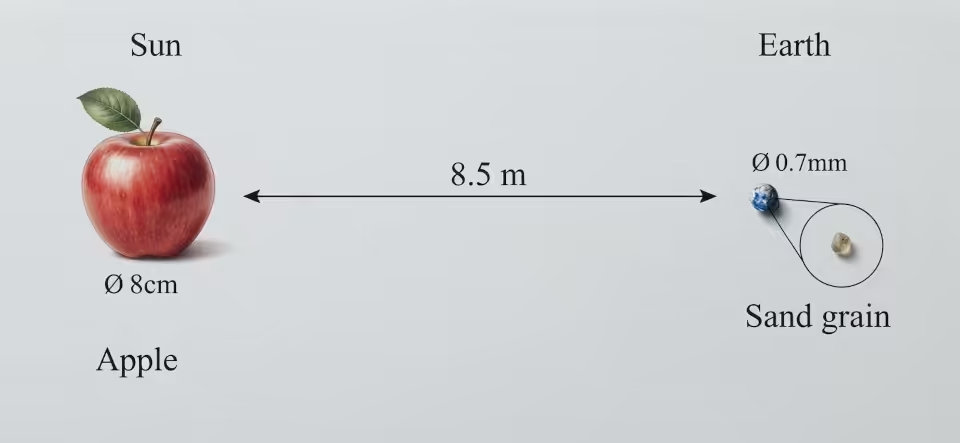
Because Earth drifts around the Sun on a circular path (minimally elliptical) at an impressive 30 km per second, another, outward apparent force shows up in this rotating Earth–Sun system — the centrifugal force. That is the force that would like to put you in the ditch when you take a bend. Our blue planet, alias the sand grain, moves on a fairly constant path where, in our simplified model, the inward gravitational force and the outward centrifugal force are equal for now, so we neither end up in the ditch nor zip off toward another galaxy.
- Earth’s orbit around the Sun is stable because attraction equals centrifugal force.
02 // Differential force
Earth is not a point mass
… but a pretty blue sphere, an ellipsoid of revolution more than 12,000 kilometres across. Blue, because well over two thirds of Earth’s surface is covered by water, which, unlike solid matter, is extremely easy to shift. Anyone who doubts it can simply carry a brim-full bowl of water from our scene of the crime in the bathroom into the kitchen.
At the force-neutral centre of the Earth there is a time-averaged balance of the Sun’s attraction and the centrifugal force. The Sun’s attraction changes with the inverse square of the radius: twice as far away means only a quarter of the pull. Centrifugal force increases linearly with radius if the angular velocity stays the same: twice as far away means twice the centrifugal force.
This tugs, stretches and, together with Earth’s own rotation, also squashes it. From this distribution of forces, and because water is so easily shifted, two tidal mounds form — to put it vividly — sometimes called water mountains. Given Newtonian physics and a height of about 24 cm, that however looks badly over the top. Those two mounds keep their position relative to the Sun and, because Earth turns exactly once on its axis in 24 hours, they represent the so-called semi-diurnal solar tide S₂. The forces responsible, which actually form a spatial force field, are vividly called tidal forces.
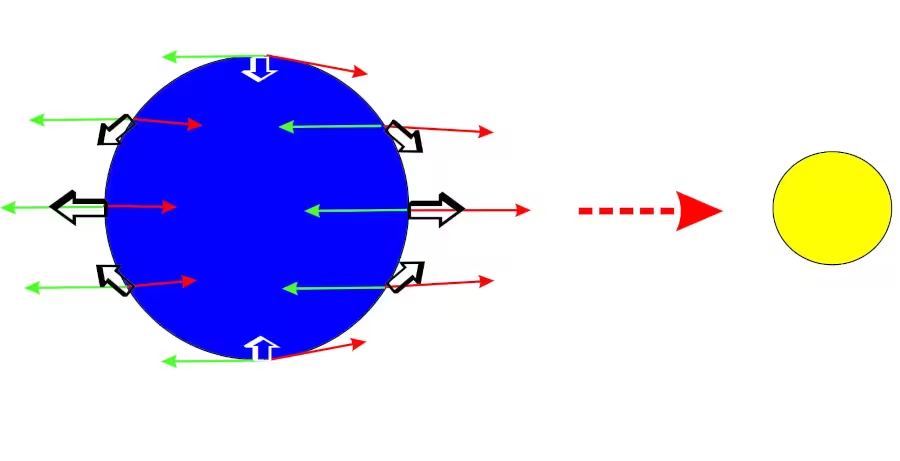
- In the Earth–Sun system the tidal forces are greatest at the zenith and the nadir.
03 // Moon
Much the same: the Earth–Moon system
On the scale chosen above, with an Earth the size of a grain of sand, the Moon would sit 2.2 cm from that grain. It would measure 0.2 mm, so still quite visible. It goes around Earth once in just under 30 days, so each day it stands 12 degrees further east, or just under 50 minutes of Earth’s turning. We observe pretty much this same interval when tidal high water comes in.
The Earth–Moon system turns about a shared centre of mass (the barycentre), where attraction and centrifugal force are likewise exactly in balance. Because Earth is about 80 times heavier than the Moon, that shared centre of mass (think of the seesaw in the playground) even lies inside our planet, about 4,500 km from Earth’s centre. On the side facing away from the Moon, centrifugal force outweighs the weakened lunar attraction. Just as before, the Earth–Moon system is an interplay of centrifugal and attractive forces, and they act directly on the movable water masses of the oceans. Earth’s own spin, once in 24 hours, produces no centrifugal forces as far as the tides are concerned. Attractive and centrifugal forces in the Earth–Moon system are about twice those between Sun and Earth; you can work that out with a reasonable effort — or, at this point, you can just take it on faith. Ebb and flood vary in intensity. That comes from the different rotational motions, namely Earth’s rotation once on itself in 24 h (solar tide S2) and the Moon’s rotation (lunar tide M2).
Recap
Recap — simplified look at the subsystems: Moon – Earth – Sun
Sun – Earth:
- Balance of attractive and centrifugal force at Earth’s centre,
- Excess of attractive forces on the Sun-facing side,
- Excess of centrifugal forces on the side facing away from the Sun,
Moon – Earth:
- Balance of forces at the common centre of mass of Earth and Moon
- Excess of attractive forces on the Moon-facing side,
- Excess of centrifugal forces on the side facing away from the Moon.
04 // Ocean
With Sun, Moon and Earth, our knowledge now gets practical
At this point the tidal awareness level is almost reached. What is still missing is the superposition of the motions of the Sun, Earth and Moon. Whether it is wise to park near a tidal water at full or new moon, we can answer for ourselves in a few moments.
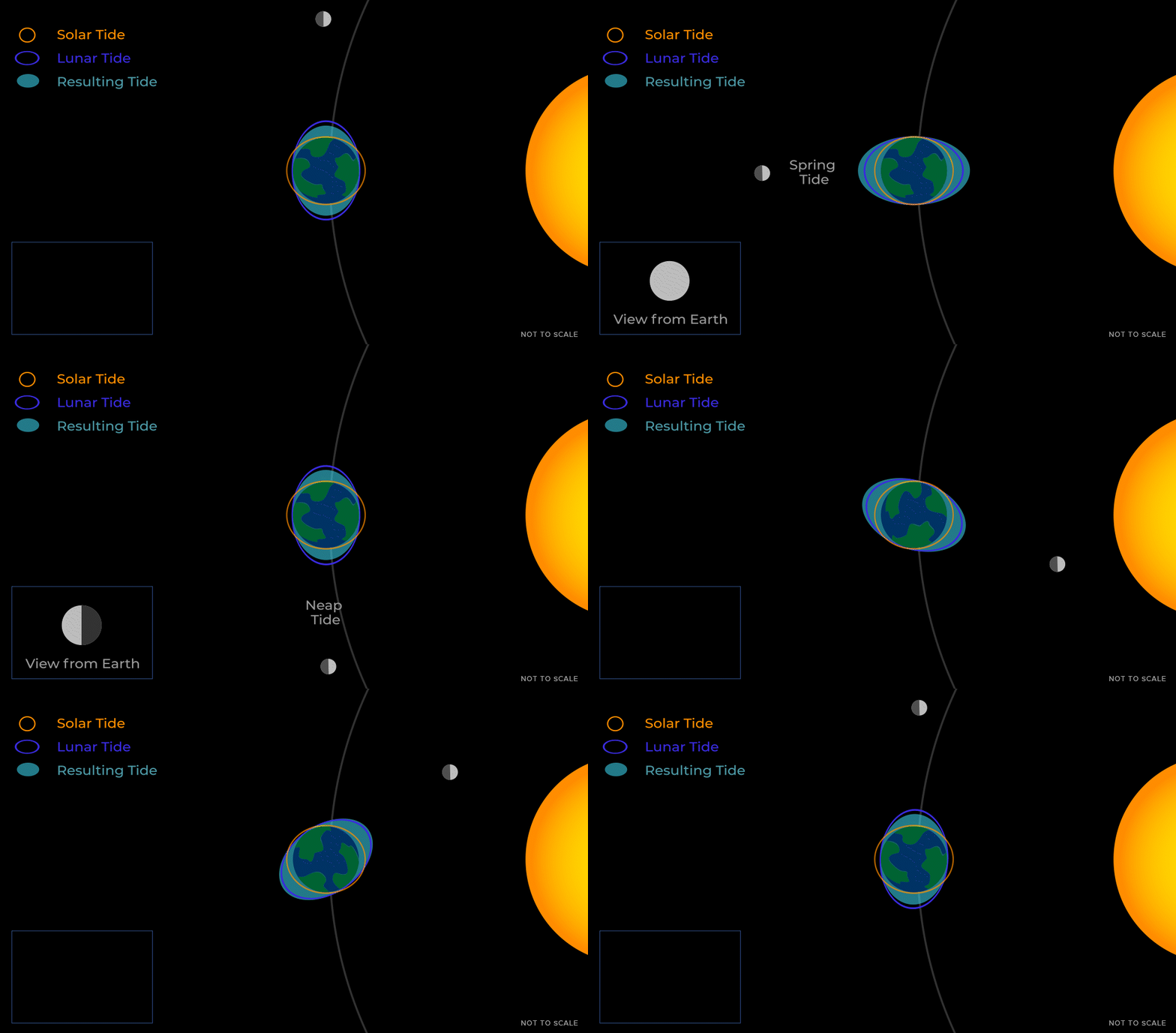
Here are a few figures and what they mean:
- Tropical year: 365.24219 days. The ordinary length of time until our Earth, as seen from the fixed stars, has taken up the same position again — in other words, has run through its orbit once. One immediately understands why we need an “extra” day every four years.
- Synodic month (lunar orbit from new moon to new moon): 29.53059 days. With this precise number one could, in theory, set a location-dependent notification for parking at tidal waters, for a lifetime. The figures given are averages, though. In practice one would still have to refine that a bit.
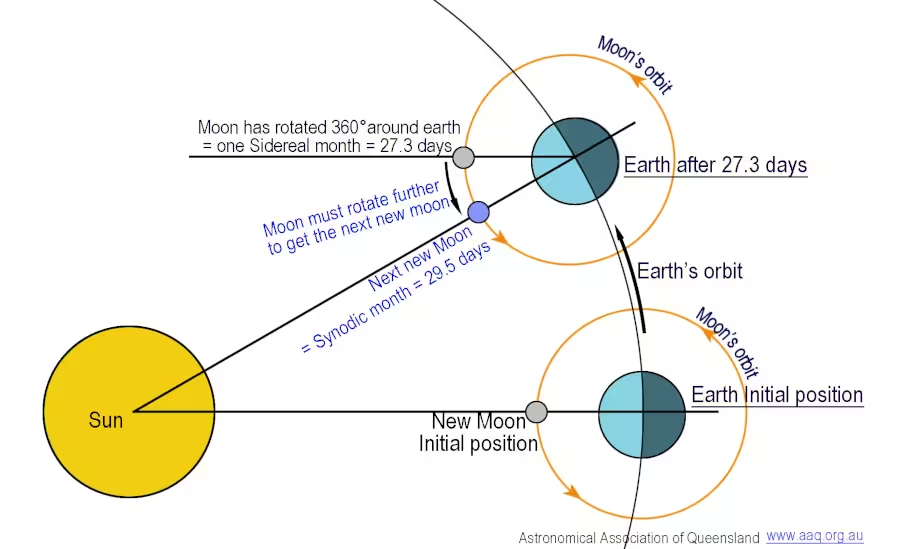
- Sidereal month (lunar orbit relative to the fixed stars): 27.32166 days. The figure below shows quite well that the Moon always needs a little more than one full revolution (27.32166 days) to get from new moon to new moon. The reason is that Earth keeps turning onward on its curved orbital path. The starting point in the Sun–Moon–Earth figure is the horizontal line. To the next point in 27.3 days. The Moon then has the same position relative to us (9 o’clock), but that would not be a new moon (see figure). For the Moon to stand again in the Avengers convergence and at new moon, another 2.2 days of orbital time are needed.
- Tidal day / lunar day (interval between two lunar culminations at a given place): 24.8412 hours (or 1.0351 days). The solar day is our ordinary day of 24 hours. It is called that because an observer on Earth has exactly the same angle to the Sun again after 24 hours, for example always seeing the Sun in the zenith. The lunar or tidal day is similar, only here the Moon is what matters for the observer. Earth and Moon rotate in the same sense. After one (solar) day the Moon has also moved on a little, and Earth still has to turn for a good 50 minutes until the observer sees the Moon as on the previous day. Because of this mismatch between solar day and lunar day we see the Moon at a constantly changing angle to the Sun. Therefore we see the Moon relative to the Sun at a constantly changing angle, see different crescents, a full Moon or no Moon at all. Looking from “above”, far above the North Pole or from the Pole Star down onto the Earth–Sun–Moon system, from the moment of full moon we see the illuminated side of the Moon more and more from the side. Because, seen this way, the Moon turns counter-clockwise, a crescent lit on the left means a waning Moon, and a crescent lit on the right a waxing one.
05 // Real tides
Real tides with friction, tidal lag, basin oscillations and amphidromes
In a frictionless ocean the water would follow the astronomical drive at once, especially if there were no continents. In fact the tide-generating force field travels from the European Atlantic coast to the American East Coast. Earth, as we know, turns distinctly faster under the Moon from west to east. Here the water is permanently forced by the tidal force field — figuratively like a large invisible hand pushing the water through the tub. Conveniently, the mean natural frequency of the Atlantic is almost identical with the forcing from the Moon’s motion: the M₂ tide, which as a semi-diurnal component slots perfectly into that beat. When the tidal mound arrives on the European side, it is the result of a stable basin oscillation. The large water masses rub against each other, and there is mass inertia as well.
The tidal wave enters the North Sea from the south through the English Channel. A little later, delayed, the tidal wave at the north coast of Scotland, or at the opening of the North Sea between Scotland and Norway, swings — by refraction — into the distinctly shallower North Sea and is pressed by the Coriolis force toward the east coast of England. Off the French–Belgian and Dutch coast it is reflected and again deflected by the Coriolis force toward the Dutch, German and Danish coast. Because of the travel times through the Atlantic and the North Sea there are distinct delays of the tides. So when we in Hamburg experience the astronomical peak of spring through the superposition of M₂ and S₂, the big water of the wave is only on its way, or follows with a time lag. Wave dynamics and geometry (cf. the NASA animation of the ocean motion) produce regions worldwide where the tidal range is small or gone altogether: the so-called amphidromes. On the west coast of Denmark the tidal wave is strongly weakened and finally leaves the North Sea along the south coast of Norway.
This is a good moment to look at the water-level map, or more precisely at the playback area in the top-left of the menu. There the tidal dynamics described here can be followed directly from measurements at coastal tide gauges for the last 25 hours.
Sea Level Map
Explore tidal dynamics and live water levels across the North Sea, the Channel, and parts of the Atlantic — in real time.
Launch map06 // Seasons
Seasons: or how Earth turns around the Sun
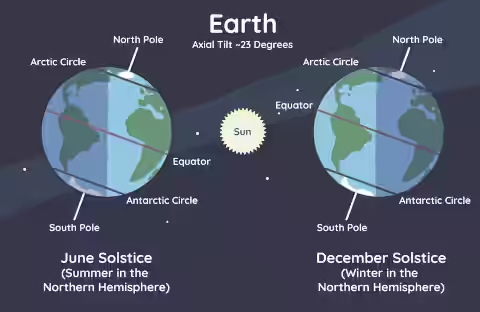
Earth moves once around the Sun in 365.25 days on a slightly elliptical orbit. As it does so it spins like a top about an imaginary axis between the North and South Poles. That axis is quite stable and, in the Northern Hemisphere, points toward the Pole Star, which is gladly drawn as a fixed star — fixed because it does not change. The rest of the starry sky circles permanently around this fixed point in the sky. The axis between the North and South Poles does not stand at a right angle to Earth’s path around the Sun; it is tilted by 23.5° out of that right angle.
With a little spatial imagination one can picture that this tilted axis, when it is summer here in the Northern Hemisphere, points toward the Sun, so the sunbeams strike exactly there at a steeper angle. Instinctively, when we want to feel the Sun on our face, we turn toward the Sun in just the same way. An angle of 45° away from that best direction we notice at once, because the Sun feels distinctly cooler. Exactly this “turning away” happens to Earth inevitably, because its axis stands virtually fixed in space and is tilted. What leans toward the Sun in summer leans, half a year or half an orbit later, exactly away from the Sun. The sunbeams strike much more flatly, the face is turned aside, and we can already guess: it is winter. If Earth’s axis stood at a right angle to its orbit, there would be no seasons.